Search This Blog

Thursday, November 17, 2011

Epitaph- The Death of Emperor Gaius Julius Caesar Augustus- 14AD


Post Mortem
Author: Anonymous

The life of our late Emperor may be remembered past the reckoning of all mankind now living. His name will surpass the withering hand of time, and be a figure for future leaders to reckon themselves against.

The legacy he left behind, captured by Horace in his "The Reign of Augustus":

"Caesar has put in order everything;
Caesar has set the bounds; has cast out vice;
And calls back home the ancient arts that our
Forefathers knew, by which the name of Rome
Is Spread from where the sun comes up at dawn
Over to where the sun goes down at night.

The structure of our grand Empire the future there of is owed to Emperor Augustus. There is no where in this world that will not know his name, nor forget his accomplishments.
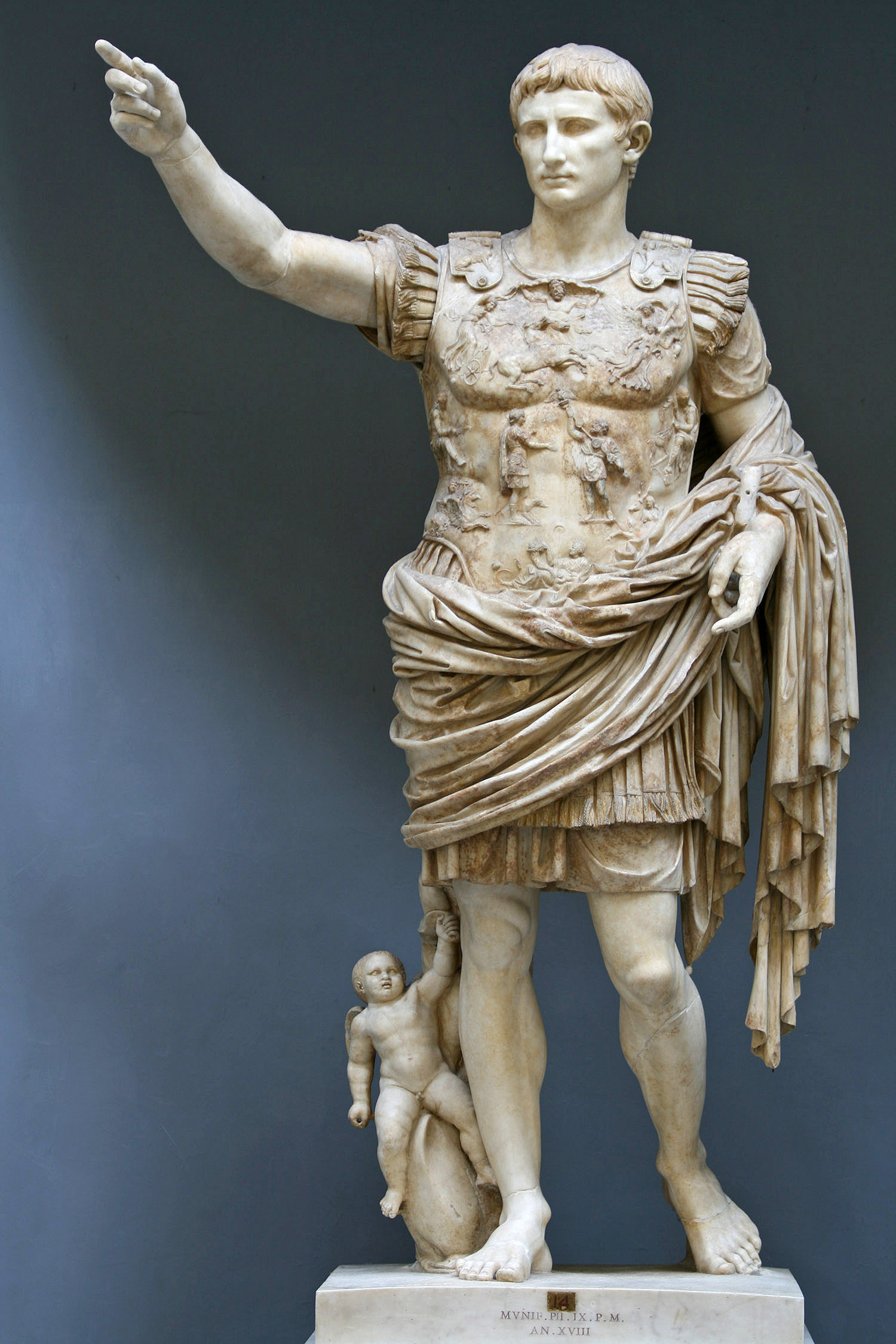
We must look at the Prima Porta (above) as a representation of who this great man was to all. In this stone personification the Senate sees a man who saved them from the chaos of power and lure of wealth; he taught them that the public was the source of their power, Horace describes "... in the time of Caesar the farms grow fat". The roots of a nation are its people.

The people, dutiful citizens loving of their empire see the Prima Porta as a message and lesson. This statue depicts Augustus' legendary ancestor Aeneas through Venus' cherub messenger at his ankle. This holy image paired with his heroic stance gesturing into the distant future with strength inspires that same holiness and strength in the people.

The final place of this majestic work is the villa of the late Emperor's wife Livia Drusillia, its presence there reminds us of the man he was. He was a quiet man with his power and authority, and a man of family and love. He loved his people as his family, and his service to both was full of dedication and honor.

In remembrance we hold the Emperor among his uncle Julius, Alexander, and even Hammurabi. We must not forget the fortitude by which his law was carried out, nor his immense wisdom and understanding of the workings of people and the Roman Empire. He ruled with charisma, understanding, and subtly; these qualities must never be forgotten. For those who wish to lead must be like Augustus, and lead their people to glory and happiness.

Wednesday, November 16, 2011

Reminiscence and Accounting - 10 AD

Poor and doubting Virgil whose "imperium sine fine" is present in the Empire now, and is not merely an ideal in hindsight! From northern Gallia and western Hispania to the ancient Aegyptus to the south Rome rules with authority and lasting strength. Now in my last days I reflect how I obtained my power, and who I owe thanks for my current position.

I suppose my father would be one to thank, for his blood alone at least. His death came when I was but a child, and so I do not recall any of his features except those in the mirror.

My mother and step father -Lucius Marcius Philippus- are next, I suppose. They are long dead by now, but they never truly did anything to educate me besides give me a place to dwell.

For the truth of the matter is the single most influential person in my past and in whose debt I am in is Julia Caesaris. Uncle Julius' sister essentially raised me, and in my advancing age I wonder what she thought of me. For now I have many children adopted and otherwise all of whom I am extremely fond of. Was I as difficulty? Did I fight with such indignation to get my way? I thank her for all I am in this life of glory and conquest.

Her death and my accompany speech marked a transition in my life, I was twelve, and on the verge of adolescent. Aunty must have taught me some sense, four year later I donned the toga and joined the Pontiffs. A year after that I was charge with the administration of the Greek Games! As I sit contemplating my past deeds of war I believe associating with the bureaucracy in those early years was the most difficult!

I asked Tiberius just the other day "there comes a moment in a man's life when he remembers all the men he has killed, all the suffering, and all the chaos and feels nothing but sorrow. The same man however remembers also the pride, the taste of victory, and sheer joy for all he has done. Is the man happy?"
As a the good, smart, witty son that he is, he answered, "I say that man is happy, father."
Curious I asked his reasoning, he thought for a moment then said, "that man is not dead."
I laughed and congratulated him, for at that point he felt life a mere boy once again!


Tuesday, November 15, 2011

Ara Pacis and My Honor- 13 BCE

The Ara Pacis, the Altar of Peace is the thanks I received from the Senate for my "peacekeeping missions". This structure eloquent sets in stone my accomplishments for the Empire; its gravel service ground to portray my service to Rome and her people. My reaction to this? Is it an honor to be given gifts by those who's own power was useless to save a nation? They could not use their wealth to save Rome, but when I step in they offer gifts! To what ends? To placate me into giving them more power? Do they truly want to honor me?

I say it is of little concern to me! My honor is Rome's; she is my life and concern. From the Victory Monument of the Alps to my Arch in the heart of Rome! My service to the empire through this stone is incarnate through immortal flesh to weather the ages and stand testament to Rome's might!

I found Rome a city of bricks and left it a city of marble!


I gave Rome a backbone of rock and earth, sowing the seeds of greatness that will lead her into a Golden Age! I will set the example through not only present self, but the figure who is remembered as the gave Rome a legacy to build upon once again.

I suppose I should thank the Senate, for using their hard earned pecunia for my honor! For it is not only mine but my people's accomplishments they celebrate. I am a tool, a scale, a weapon for the people and for Rome! The nummus the Senate sits upon like fattened hens has not been wasted; I and the glory of Rome shall live on through the Ara Pacis and other monuments!

Hasten Slowly: As Pricipate (date nonspecific)

As I sit alone in the evenings as twilight settles gently across the horizon I am completely at ease with the pace of recovery in the Empire. The Senate has proved easy to manipulate as far as policy and economics; they are well aware of my military backing. A wise man once said however, "the art of war is to win without a fight," which I hold very dear to heart. The Senate has elected me Augustus as "pricipate" bestowing upon me most (if not all) powers of state, but despite this power I have no wishes to abuse this power. I am a servant of the Empire as is every other of Roman blood; I am responsible for the people and their well being. This duty is a heavy burden, and the power that is inherent with that great weight. I cannot let my people down.

With my now strong influence upon the affairs of state I choose to rule from the background. Of course the armies support brightens the portrait quite a bit. The once vibrant senate and nobles have become gray figures with no artistic fortitude in my painting of Rome! The common people are my benefactors, and it is for them I must be swift in my strokes and gentle in my technique. To act to rashly would destroy the foundation of trust in the administration, and then chaos will ensue once again.

The centralized senate is blind to the woes of the common citizen of Rome, and even if they were aware problems would still be rampant. The leagues and leagues of our great state contains peoples of many backgrounds and culture; They are united by one thing: Roman Citizenship! A intangible stamp of civility and worth that none may take away freely. These people do not need a stagnant and quibbling oligarchy system that is based in a distant capital! They need very little in order to function as does our brilliant government. The people need a local ruler whom they are adjusted to; someone who understands their plights and woes. These leaders do not need to be very competent, but they need to be rooted in their people. The Roman government needs little only: peace, good orders, and taxes. If the people or the provincial ruler does not comply, we may simply intercede with a military statement or demonstration to set order once again.

The determination of the populous always overwhelms the whims of the few and opulent. I must simply use my authority to balance the scale between these factions. The disparity of wealth is not as vital for these groups as the disparity of power.

Saturday, November 12, 2011

The Throne of Rome 44-27 BCE

The figure of Julius Caesar is that of dictator of Rome; despite his power and authority he was still assassinated. With his assassination the rule of Rome fell upon the shoulders of Mark Antony, Marcus Aemilius Lepidus, and I then known as Octavian. The bonds which bond us were weak and fraught with deceit and struggle for power. It could not last. Only a single ruler could unite the still unstable empire and save it from itself.

Lepidus was driven into exile, and I cornered the adulterous Antony at the Battle of Actium where he and his lover Cleopatra committed suicide. I had learned my lesson on power at this point. I knew that shear will and strength would not lead my empire to success. I needed balance and legitimate power that all citizens would recognize, and not just be the single image of power in my new empire.

The key to giving the illusion of power to the people is to support them, and not oneself. Contradictory? That as the most powerful man in my empire I must submit to the will of the people? Uncle Julius was a figure of absolute power, but look what happened to him. Did he not also want glory for Rome? I am the one military and political leader of any significance in the Empire, and for those who wish power for their own to take a selfish position would lead me to the same fate as my late uncle.

The throne of Rome is completely mine, but what is Rome but its people? Are we or are we not an agrarian society at our deepest root? The farmer is just as capable of rebellion as any solider or discontent. It is for this reason and for the health of the Empire that all must be content with their own significance within its borders. This is my calling to rule wisely and with gravity aware of the mistakes of my predecessors, and set a standard for my successors to rule for the glory of Rome.